-
🧠 Semantic Understanding of Queries
Uses Sentence-Transformers to generate dense embeddings that capture the meaning behind user questions, rather than relying on keyword matching.
-
⚡ Fast and Accurate Semantic Search
Employs FAISS (Facebook AI Similarity Search) for rapid and efficient retrieval of the most relevant medical records from large datasets.
-
🩺 LLaMA Integration for Contextual Responses
Leverages LLaMA’s generative capabilities to produce coherent, human-like explanations of medical concepts, ensuring clarity and reliability.
-
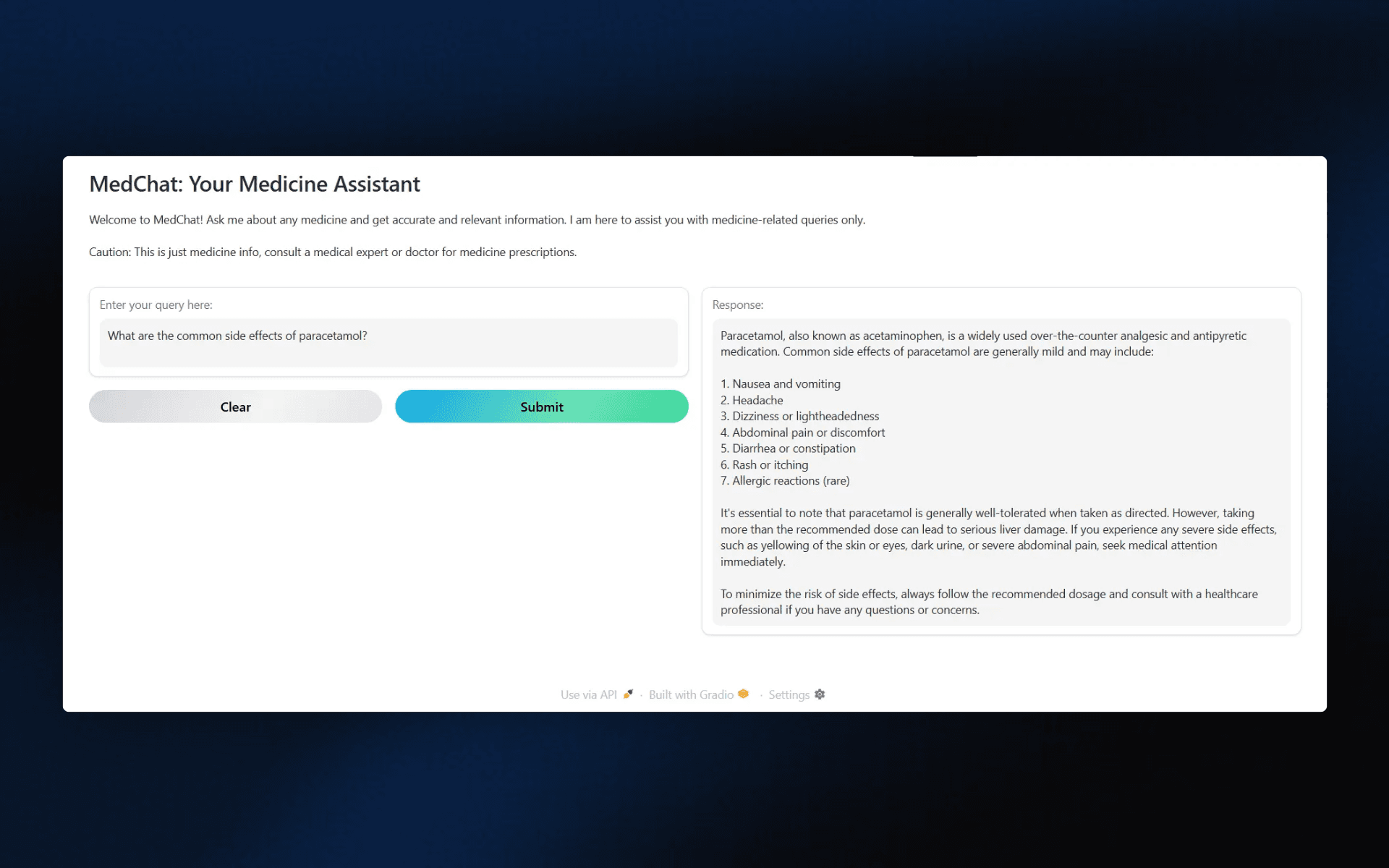
💬 Interactive Gradio Interface
A simple, accessible web UI built with Gradio that allows users to ask natural-language questions about medications and receive detailed answers in real time.
-
🧾 Medical Knowledge Base
The system is backed by a curated dataset of medicine information, including composition, dosage, usage instructions, and side effects.
-
🔍 Robust Query Handling
Handles diverse query types — from “What is Paracetamol used for?” to “Which drugs interact with Ibuprofen?” — with accurate semantic matching.
- Language Models: LLaMA, Sentence-Transformers (all-MiniLM-L6-v2)
- Vector Search: FAISS (Facebook AI Similarity Search)
- Frontend: Gradio
- Data Source: Custom-compiled medical dataset (CSV)
- Deployment: Hugging Face Spaces
- Libraries: Transformers, FAISS, NumPy, Pandas
The system follows a hybrid retrieval + generation architecture:
-
Data Preparation Layer
- Preprocesses medical datasets and creates dense vector embeddings using Sentence-Transformers.
- Stores these vectors in a FAISS index for fast similarity search.
-
Query Processing Layer
- Converts user questions into embeddings.
- Retrieves top-k similar entries using cosine similarity search from FAISS.
-
Response Generation Layer
- Passes retrieved context to LLaMA, which generates a natural, conversational response based on the retrieved facts.
-
User Interface Layer
- Gradio interface manages input, displays responses, and provides conversational flow in an easy-to-use chat layout.
-
Ensuring Medical Accuracy:
Validated information sources and enforced retrieval constraints to ensure only verified and factual responses.
-
Optimizing Latency:
Used FAISS’s flat index and batch embedding techniques to achieve real-time query performance even with large datasets.
-
Balancing Generation and Retrieval:
Carefully tuned LLaMA prompts to ensure responses stayed factual and concise rather than overly generative.
-
Dataset Preparation:
Cleaning and standardizing medical terminology across various data sources was key to improving retrieval accuracy.
- Delivered a high-accuracy medical chatbot capable of answering diverse queries about medications with contextual understanding.
- Reduced search latency to under 200ms for large datasets using FAISS.
- Demonstrated how semantic search + LLM integration can transform medical information systems into accessible, intelligent assistants.
- Improved user trust and engagement through transparent citations and explainable responses.
This project highlights your expertise in semantic search systems, LLM integration, and NLP application development.
It demonstrates your ability to combine vector-based retrieval (FAISS) with language model reasoning (LLaMA) to build domain-specific, intelligent conversational systems — particularly valuable for healthcare AI, knowledge assistants, and information retrieval applications.